What is 52 − 27?
Write the numbers in columns, tens under tens and ones under ones, and start with the ones.
- The ones: 2 − 7. There aren't enough ones to take 7 away.
- Regroup a ten. Take 1 ten from the 5 tens and change it into 10 ones. Now there are 4 tens and 12 ones.
- The ones again: 12 − 7 = 5.
- The tens: 4 − 2 = 2.
So 52 − 27 = 25. Check by adding back: 25 + 27 = 52.
Some people call regrouping “borrowing”. Schools say regrouping, because nothing is given back: the ten is changed into ten ones.
When there's a zero
What is 304 − 128? The ones need regrouping, but there are 0 tens to take one from.
- Regroup a hundred first. 3 hundreds become 2 hundreds and 10 tens.
- Now regroup a ten. 10 tens become 9 tens, and the ones become 14.
- Subtract each column: 14 − 8 = 6, 9 − 2 = 7, 2 − 1 = 1.
So 304 − 128 = 176. Check: 176 + 128 = 304.
The common mistakes
- Taking the smaller digit from the bigger. For 52 − 27, a child who does 7 − 2 in the ones gets 35. The number on top is always the one you take away from.
- Forgetting the tens went down. After regrouping, the 5 tens are only 4. Crossing out the 5 and writing 4 above it helps.
- Getting stuck at a zero. Go one column further left and regroup from there, as in 304 − 128.
Try these
- 63 − 28 = ___
Show answer
35. Regroup a ten: 13 − 8 = 5, then 5 − 2 = 3. - 90 − 34 = ___
Show answer
56. Regroup a ten: 10 − 4 = 6, then 8 − 3 = 5. - 425 − 163 = ___
Show answer
262. The ones need no regrouping (5 − 3 = 2); the tens do: 12 − 6 = 6, then 3 − 1 = 2. - 342 − 118 = ___
Show answer
224 - 500 − 237 = ___
Show answer
263. Regroup a hundred, then a ten: 10 − 7 = 3, 9 − 3 = 6, 4 − 2 = 2.
Helping at home
- Use dimes and pennies: change a dime for 10 pennies when there aren't enough pennies. That's regrouping.
- Estimate first: 52 − 27 is about 50 − 30, so the answer should be about 20.
- Check every answer by adding back.
- Say the columns' names as you go: ones, tens, hundreds.
What school expects
In 2nd grade children “add and subtract within 1000, using concrete models or drawings and strategies based on place value”, and learn that subtracting sometimes means decomposing a ten or a hundred (Common Core 2.NBT.B.7). In 3rd grade they do it fluently.
Where the minus sign comes from
The + and − signs first appeared in print in 1489, in a German arithmetic book for merchants by Johannes Widman. Before that, people wrote the words out.
How Island Explorers teaches it
Adding and taking away is a farm of islands. Columns start here:
| Island | What it covers | Grade |
|---|---|---|
| Apple Orchard | Adding and taking away to 100: tens, ones, crossing a ten, stories | 2nd grade |
| Harvest Barn | Adding and taking away in columns: two digits, then regrouping | 2nd grade |
| The Hayloft | Three columns: regrouping once and twice, zeros, and estimating | 3rd grade |
| Sunflower Field | Four columns: regrouping in any column, zeros, checking and estimating | 4th grade |
The columns are drawn on screen, with a box for each digit, so your child works the method exactly as they would on paper.
Free printable worksheet
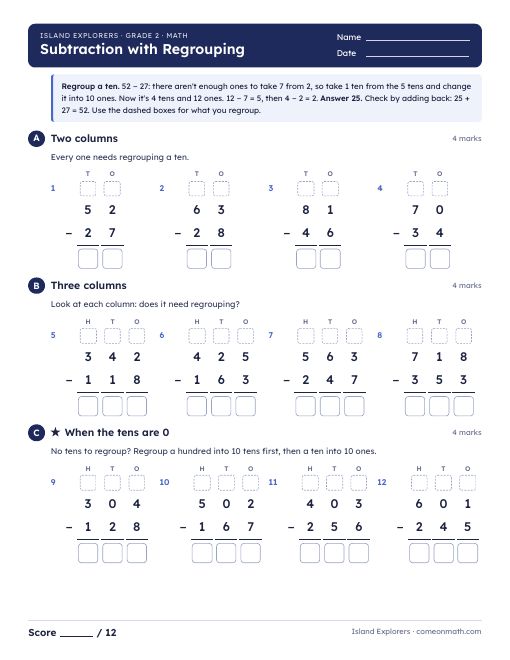
12 subtractions in columns: two digits, three digits, then a ★ challenge with a zero in the tens. With an answer page and the usual slips to look out for.
Download the free worksheet (PDF)
Prints on US Letter paper. Free to print and share with your child or class.