What is the 4 in 342 worth?
Each digit's value depends on its place:
| Hundreds | Tens | Ones |
|---|---|---|
| 3 | 4 | 2 |
The 4 is in the tens place, so it's worth 4 tens: 40. The 3 is worth 300 and the 2 is worth 2. So 342 = 300 + 40 + 2.
Ones, rods and flats
- 10 ones make a ten. In school this is often a rod of 10 small cubes.
- 10 tens make a hundred. Ten rods side by side make a flat square: 100.
- Every place is worth 10 of the place to its right. That's why 10 more than 395 is 405: the tens go up by one, and 10 tens become another hundred.
Zero holds a place
706 is 7 hundreds, 0 tens and 6 ones. The 0 says there are no tens, and keeps the 7 in the hundreds place. Without it, 76 is a much smaller number.
Comparing numbers
Which is greater, 398 or 401? Compare the hundreds first: 3 hundreds and 4 hundreds. 4 hundreds is more, so 401 is greater, even though 398 has bigger digits after the hundreds. Only when the hundreds are the same do you look at the tens, then the ones.
The common mistakes
- Writing what you hear. “Three hundred and four” written as 3004: a 300 and a 4 side by side. Ask: how many hundreds, how many tens, how many ones? 3, 0, 4: 304.
- Forgetting the zero. Seven hundred and six written as 76.
- Comparing digit by digit from the right. The place furthest left decides first.
Try these
- What is the 6 in 563 worth?
Show answer
60. It's in the tens place: 6 tens. - 400 + 20 + 7 = ___
Show answer
427 - Which is greater, 509 or 590?
Show answer
590. Both have 5 hundreds; compare the tens: 0 and 9. - What is 10 more than 395?
Show answer
405. 9 tens and 1 more ten make 10 tens, which is another hundred. - What is 100 less than 306?
Show answer
206. Only the hundreds change.
Helping at home
- Use money: £1, 10p and 1p coins are hundreds, tens and ones of pence. £3.42 is three £1 coins, four 10p coins and two 1p coins.
- Split numbers you see, on doors, buses and price tags: 215 is 200 and 10 and 5.
- Play “10 more, 100 more”: say a number and take turns adding 10 or 100.
What school expects
In Year 2 children learn to “recognise the place value of each digit in a two-digit number (10s, 1s)”, and in Year 3 to “recognise the place value of each digit in a 3-digit number (100s, 10s, 1s)” (National Curriculum).
Where our digits come from
The digits 0 to 9, and the idea that a digit's place gives its value, came from India and reached Europe by way of mathematicians in the Middle East. The Romans had no zero, which is why their numbers are written so differently.
How Island Explorers teaches it
Place value is a forest trail of islands:
| Island | What it covers | Year |
|---|---|---|
| Mossy Log | Tens and ones to 100 | Year 2 |
| Hundred Oaks | Hundreds, tens and ones to 1,000: compare, order, 10 and 100 more | Year 3 |
| Acorn Point | Tenths and hundredths: the decimal point | Year 4 |
Your child builds numbers from blocks, splits them, and places them on a number line, one small step at a time.
Free printable worksheet
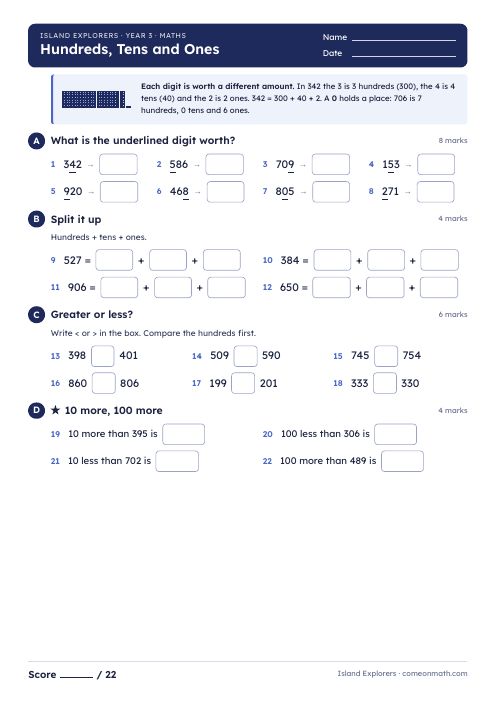
22 questions: what each digit is worth, splitting numbers up, greater or less, then a ★ challenge with 10 more and 100 more. With an answer page.
Download the free worksheet (PDF)
Prints on A4 paper. Free to print and share with your child or class.