Is 1/2 the same as 2/4?
Take two strips of paper the same length.
- Fold the first in 2 equal parts and colour 1 part: that's 1/2.
- Fold the second in 4 equal parts and colour 2 parts: that's 2/4.
The coloured parts are exactly the same length. So yes: 1/2 and 2/4 are the same amount, written two ways. Fractions like these are called equivalent fractions.
Times the top and the bottom
To make an equivalent fraction, multiply the numerator (the top number) and the denominator (the bottom number) by the same number:
- 1/2 = 2/4 (times 2) = 3/6 (times 3) = 4/8 (times 4).
- Missing numbers: 3/4 = ?/12. The bottom went from 4 to 12, which is times 3, so the top goes times 3 too: 9/12.
- Simplifying goes the other way: divide the top and the bottom by the same number. 6/8 = 3/4 (both divided by 2).
Why it works: times 2 cuts every part in half, so there are twice as many parts, and twice as many are coloured. The amount stays the same.
The common mistakes
- Adding instead of multiplying. Adding 1 to the top and the bottom turns 1/2 into 2/3, which is more than a half. Only multiplying or dividing keeps the fraction the same.
- Changing just one number. Times the bottom but not the top, and 1/2 becomes 1/4: a different fraction.
- Thinking bigger numbers mean a bigger fraction. 4/8 has bigger numbers than 1/2, but it's the same amount.
Try these
- 1/3 = ?/6
Show answer
2. The bottom is times 2, so the top is times 2: 2/6. - 2/5 = 4/?
Show answer
10. The top is times 2, so the bottom is times 2: 4/10. - Is 3/4 equivalent to 6/8?
Show answer
Yes. Times the top and the bottom of 3/4 by 2: 6/8. - Simplify 4/10.
Show answer
2/5. Divide the top and the bottom by 2. - Which one is not equivalent to 1/2: 3/6, 4/8 or 5/9?
Show answer
5/9. Half of 9 is 4 and a half, so 5/9 is a bit more than a half.
Helping at home
- Fold paper strips into halves, quarters and eighths, and line them up to see which match.
- Share a pizza or a chocolate bar: is 2 slices out of 8 the same as 1 out of 4?
- Use measuring cups when baking: two 1/4 cups fill a 1/2 cup.
- Ask the times-table question behind it: 3/4 = ?/12 is really “4 times what is 12?”
What school expects
In Year 2 children “recognise the equivalence of 2/4 and 1/2”. In Year 3 they “recognise and show, using diagrams, equivalent fractions with small denominators”, and in Year 4 “families of common equivalent fractions” (National Curriculum).
Fractions in ancient Egypt
Nearly 4,000 years ago, Egyptian scribes wrote almost every fraction with 1 on top. To write 4/7, they wrote 1/2 + 1/14 instead. Their one exception was 2/3. We know because a scribe's copy of a maths book, the Rhind papyrus, still survives.
How Island Explorers teaches it
Fractions is the Savanna, fifteen islands with their own animal guides. Equivalent fractions grow across three of them:
| Island | What it covers | Year |
|---|---|---|
| Zebra Crossing | Thirds, writing fractions, and two quarters make a half | Year 2 |
| Rhino Rocks | Comparing fractions, putting them in order, and equal fractions in pictures | Year 3 |
| Meerkat Mounds | The fraction wall, times the top and the bottom, missing numbers, simplifying | Year 4 |
Every fraction is drawn: strips, shapes, groups and number lines, so your child sees why two fractions are equal before learning the rule.
Free printable worksheet
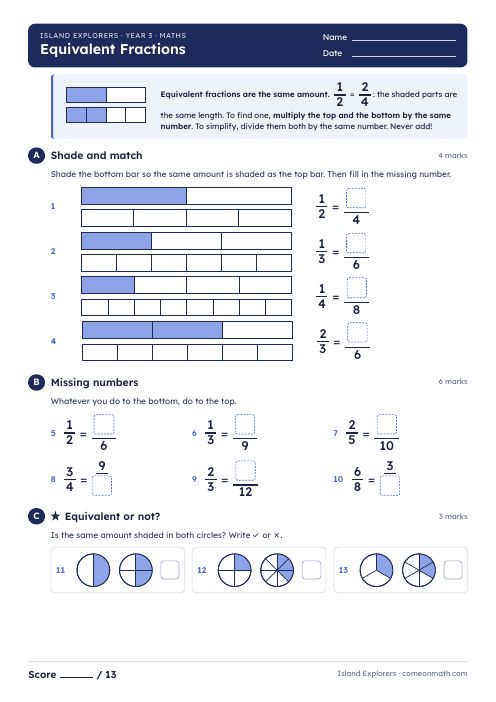
13 questions: shading bars to match, missing numbers, then a ★ challenge to spot which circles are equivalent. With an answer page.
Download the free worksheet (PDF)
Prints on A4 paper. Free to print and share with your child or class.
All the times tables (they're behind every equivalent fraction) →