What time is it?
The short hand is just past the 3. The long hand points to the 4.
- The short hand tells the hour. It's past the 3 but not yet at the 4, so the hour is still 3.
- The long hand tells the minutes. Count in 5s from the 12 to where it points: 5, 10, 15, 20.
So it's 20 past 3, and on a digital clock that's 3:20.
The order school teaches it
- O'clock and half past (Year 1): the long hand on the 12 or the 6.
- Quarter past, quarter to and every five minutes (Year 2): the long hand on the 3 or the 9, then counting in 5s all the way round.
- To the minute, clocks with Roman numerals, am and pm, and how long things take (Year 3), then the 24-hour clock (Year 4).
The common mistakes
- Reading the hour from the nearest number. At 2:50 the short hand is nearly at the 3, so it's easy to say 3:50. The hour is the number the short hand has passed, not the one it's closest to.
- Mixing up the hands. Say it out loud every time: short hand, hour; long hand, minutes.
- Times “to” the hour. 20 to 4 means 20 minutes before 4 o'clock, which is 3:40, not 4:20. Count on from the long hand to the 12: 20 minutes to go.
Try these
- The long hand points to the 6. How many minutes past the hour is it?
Show answer
30. Count in 5s from the 12 to the 6: 5, 10, 15, 20, 25, 30. That's half past. - What is 20 past 7 on a digital clock?
Show answer
7:20 - What is quarter to 5 on a digital clock?
Show answer
4:45. Quarter to 5 is 15 minutes before 5 o'clock, so the hour is still 4. - What time is 5 to 9?
Show answer
8:55. Five minutes before 9 o'clock. - How many minutes are there in an hour?
Show answer
60. Count in 5s all the way round the clock: twelve 5s make 60.
Helping at home
- Keep an analogue clock where your child can see it, and ask the time at the same moments each day: breakfast, leaving the house, bedtime.
- Count in 5s around the clock face together, pointing to each number.
- Ask what time it will be in 10 minutes, or how long until dinner.
- Use the words school uses: o'clock, half past, quarter past, quarter to, minutes past and minutes to.
What school expects
In Year 1 children learn to “tell the time to the hour and half past the hour and draw the hands on a clock face to show these times”. In Year 2 they “tell and write the time to five minutes”, and in Year 3 they “tell and write the time from an analogue clock”, including Roman numerals and the 24-hour clock (National Curriculum).
Why an hour has 60 minutes
Thousands of years ago, the Babylonians, in what is now Iraq, counted in 60s instead of 10s. We still count time their way: 60 seconds in a minute and 60 minutes in an hour.
How Island Explorers teaches it
Time is a row of harbour islands, each with its own animal guide:
| Island | What it covers | Year |
|---|---|---|
| Clock Tower Quay | O'clock and half past, setting the clock, the months and seasons | Year 1 |
| Fisherman's Wharf | Quarter past and quarter to, five minutes, minutes to the hour, setting the clock | Year 2 |
| Ferry Landing | Digital time, to the minute, Roman numeral clocks, am and pm, how long | Year 3 |
| Rocky Cove | The 24-hour clock, journeys and timetables | Year 4 |
Your child reads clocks, sets the hands themselves, and only moves on when they answer right nearly every time, on different days.
Free printable worksheet
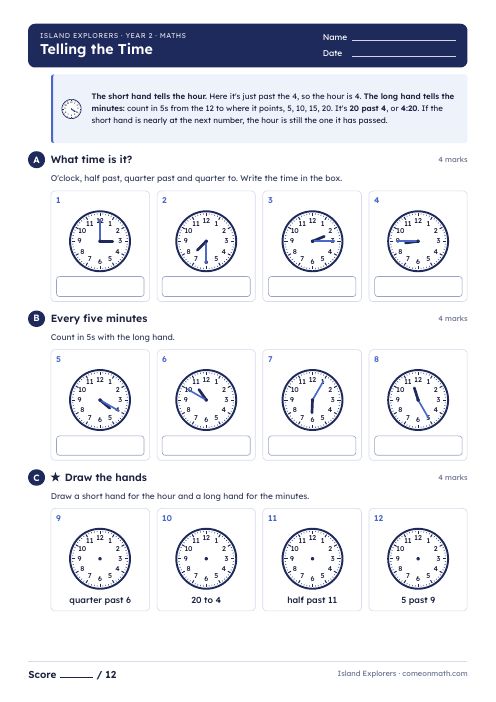
12 questions: reading the time from o'clock to every five minutes, then a ★ challenge to draw the hands. With an answer page.
Download the free worksheet (PDF)
Prints on A4 paper. Free to print and share with your child or class.
The 2, 5 and 10 times tables (counting in 5s helps here too) →